
Orientation Program for Newly Appointed and Promoted Faculty Members Held at AUST
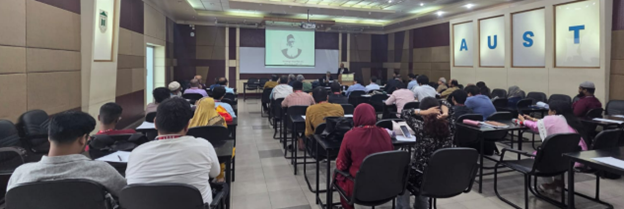
The Institutional Quality Assurance Cell (IQAC) of Ahsanullah University of Science and Technology (AUST) successfully organized an Orientation Program for the newly appointed faculty members of Fall 2025, Spring 2026, and the newly promoted faculty members on Monday, July 13, 2026, from 10:00 a.m. to 4:00 p.m. The day-long program was held at the VC Seminar Room (Level-4), Block-D, AUST, with the objective of familiarizing the participants with the university’s academic environment, administrative procedures, quality assurance practices, research culture, professional responsibilities, and institutional values.
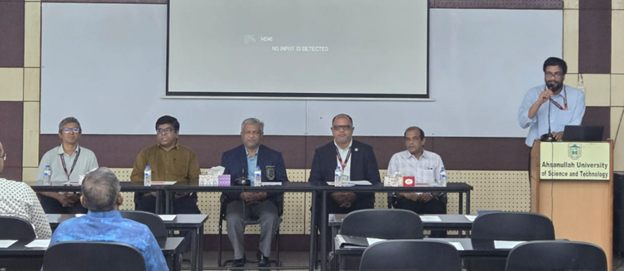
The orientation program was designed to help newly recruited and promoted faculty members gain a comprehensive understanding of AUST’s academic vision, governance structure, service regulations, financial policies, research opportunities, and expectations regarding teaching, learning, and professional conduct. The program also aimed to foster a sense of belonging and institutional commitment among the participants while preparing them to contribute effectively to the university’s continued pursuit of academic excellence.
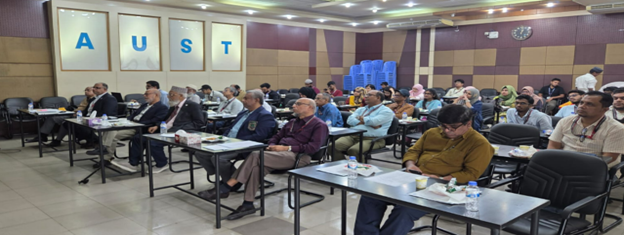
The program began with registration of the participants, followed by an engaging ice-breaking session conducted by Dr. Fakir Sharif Hossain, Additional Director (ETL), IQAC, AUST. Through a series of interactive activities, the participants had the opportunity to introduce themselves, exchange ideas, and develop professional connections with colleagues from different departments. The session created a friendly, collaborative, and welcoming atmosphere that encouraged active participation throughout the day.
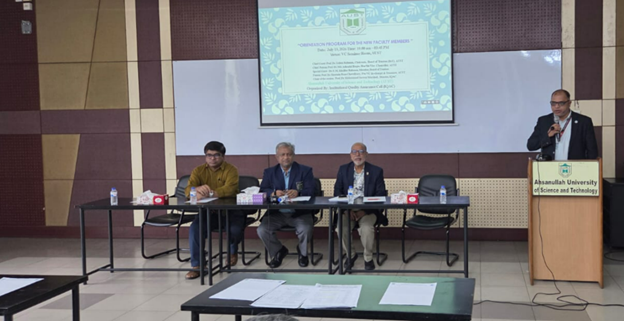
Following the ice-breaking session, Prof. Dr. Mohammad Sarwar Morshed, Director, IQAC, AUST, formally welcomed the participants and distinguished guests. In his welcome address, he emphasized that faculty members are the cornerstone of any higher education institution and play a pivotal role in shaping future generations through quality teaching, research, innovation, and community engagement. He introduced the Institutional Quality Assurance Cell (IQAC), highlighting its mission, objectives and major activities in promoting a culture of quality assurance and continuous quality improvement across the university. He also explained the importance of Outcome-Based Education (OBE), curriculum development, faculty development initiatives, academic assessment, accreditation readiness, stakeholder engagement, and evidence-based quality enhancement practices. He encouraged the participants to actively contribute to the university’s quality assurance initiatives and uphold the highest standards of academic excellence.
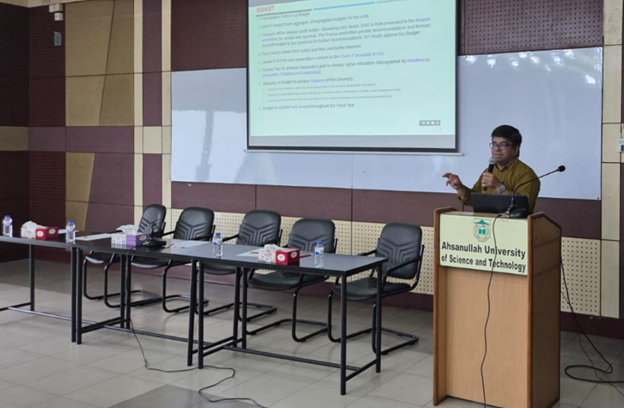
The first technical session was delivered by Prof. Dr. Sharmin Reza Chowdhury, Pro Vice-Chancellor (In-charge) and Treasurer, AUST. He provided a comprehensive overview of the university’s financial rules, regulations, and administrative procedures. His presentation covered budgeting processes, financial accountability, procurement policies, reimbursement procedures, and the responsible utilization of institutional resources. He emphasized the importance of transparency, integrity, and compliance with financial regulations in ensuring efficient institutional governance and encouraged faculty members to become familiar with the relevant administrative procedures.
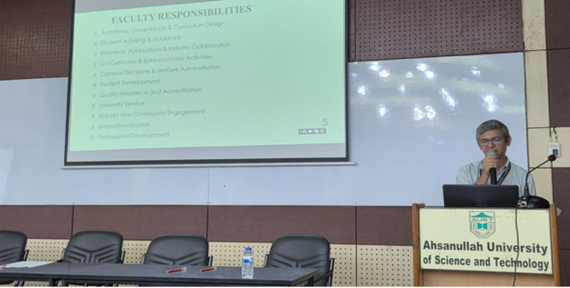
The next session was conducted by Prof. Dr. S. M. Shafiul Alam, Registrar (In-charge) and Professor, School of Business, AUST. He elaborated on the university’s service rules, organizational structure, administrative framework, and departmental responsibilities. His presentation provided practical guidance on faculty appointments, promotion policies, leave regulations, office procedures, official communication, and professional responsibilities. He also discussed the rights and responsibilities of faculty members and stressed the importance of discipline, accountability, punctuality, and adherence to institutional policies in maintaining an effective academic environment.
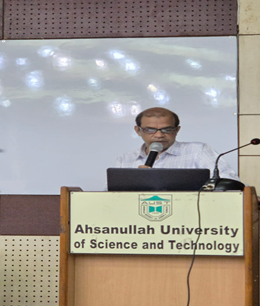
The orientation continued with a comprehensive session on developing a strong research culture at AUST, presented by Dr. Dewan Hasan Ahmed, Director, Research and Publication Office (RPO), and Professor, Department of Mechanical and Production Engineering, AUST. He discussed the university’s commitment to promoting high-quality research and innovation and explained the various research support mechanisms available to faculty members. His presentation highlighted research funding opportunities, publication ethics, scholarly journals, collaborative research initiatives, conference participation, intellectual property, and strategies for increasing research productivity. He encouraged newly appointed faculty members to actively engage in interdisciplinary research and contribute to addressing national and global challenges through impactful scholarly work.
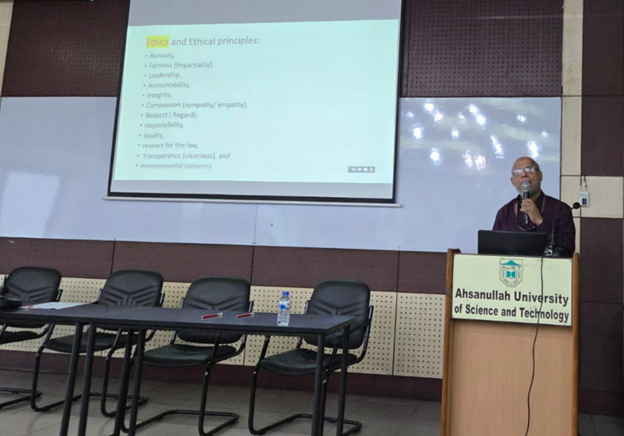
The participants then attended an insightful session on Professional Ethics and Classroom Management, delivered by Prof. Dr. Md. Abdul Matin, Professor and Dean, Faculty of Civil Engineering, AUST. He discussed the ethical responsibilities of university teachers, emphasizing honesty, fairness, integrity, professionalism, and respect in academic activities. He also shared practical strategies for effective classroom management, student engagement, learning assessment, and creating an inclusive and motivating learning environment. Stressing the importance of maintaining academic standards, he encouraged faculty members to serve as role models through their professional conduct and commitment to excellence.
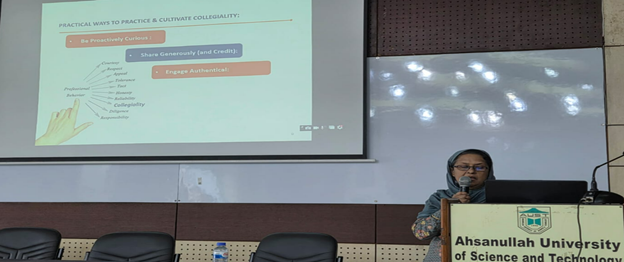
The subsequent session focused on Collegiality in the Workplace, presented by Prof. Dr. Farida Nilufar, Professor and Dean, Faculty of Architecture, AUST. She highlighted the significance of mutual respect, effective communication, teamwork, collaboration, and empathy in fostering a healthy academic culture. She encouraged faculty members to build positive professional relationships across departments, promote knowledge sharing, and work collectively toward achieving the university’s strategic goals. Her presentation emphasized that a supportive and collaborative workplace contributes significantly to institutional success and individual professional growth.
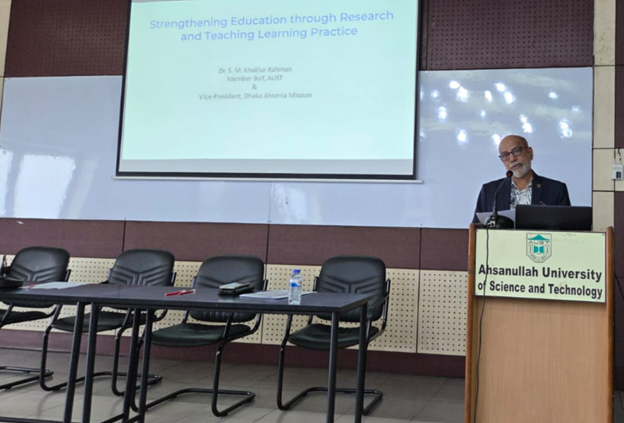
One of the highlights of the program was a special session titled “Strengthening Education through Research and Teaching-Learning Practice,” delivered by Dr. S. M. Khalilur Rahman, Member, Board of Trustees (BoT), AUST, and Vice-President, Dhaka Ahsania Mission. Drawing upon his extensive academic and professional experience, he discussed the evolving role of higher education in today’s rapidly changing world. He emphasized the need to integrate quality research with innovative teaching practices to create a dynamic learning environment that prepares graduates to meet contemporary challenges. He encouraged faculty members to continuously update their knowledge, adopt student-centered teaching approaches, and cultivate a lifelong learning mindset while contributing meaningfully to national development through education and research.
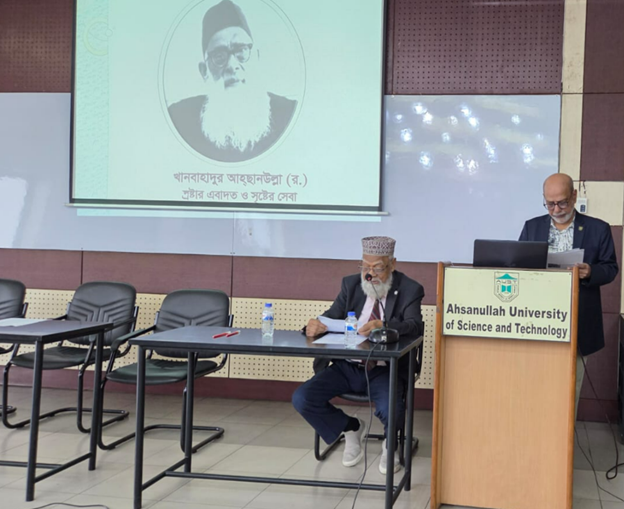
Another inspiring session was delivered by Prof. Dr. Golam Rahman, Chairman, Board of Trustees, AUST. He shared the life, philosophy, and enduring legacy of Khan Bahadur Ahsanullah, whose vision and humanitarian ideals continue to guide the mission and values of AUST. He reflected on Khan Bahadur Ahsanullah’s dedication to education, social welfare, discipline, honesty, humility, and service to humanity. He encouraged the participants to embrace these timeless values in their personal and professional lives and to contribute to building an institution that upholds excellence, integrity, and social responsibility.
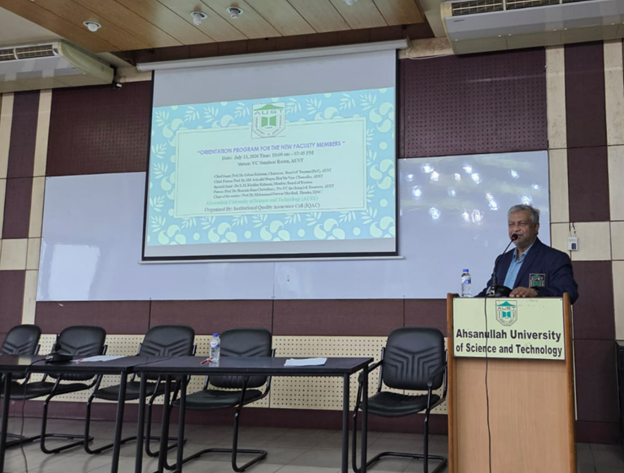
The program concluded with an inspiring address by the Hon’ble Vice-Chancellor, Prof. Dr. Md. Ashraful Hoque, who congratulated the newly appointed and promoted faculty members and welcomed them to the AUST family. In his speech, he emphasized that academic excellence is achieved through dedication, professionalism, innovation, and continuous self-improvement. He encouraged the participants to develop a strong sense of ownership and responsibility toward the university, remain committed to quality teaching and impactful research, and actively participate in institutional development initiatives. He also underscored the importance of lifelong learning, collaboration, ethical leadership, and continuous professional development in strengthening the reputation and global standing of AUST.
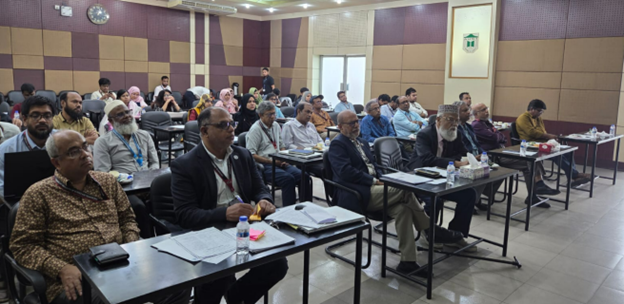
Throughout the program, the participants actively engaged in discussions, exchanged ideas with the distinguished speakers, and shared their expectations and experiences. The interactive sessions provided valuable opportunities for networking, knowledge sharing, and gaining a deeper understanding of the university’s academic and administrative systems. The orientation program successfully equipped the participants with essential knowledge and practical guidance to begin the next phase of their academic careers with confidence, professionalism, and a strong commitment to institutional excellence.
The program concluded with a vote of thanks delivered by Prof. Dr. Mohammad Sarwar Morshed, Director, IQAC, AUST. He expressed his sincere appreciation to the Hon’ble Vice-Chancellor, Pro Vice-Chancellor (In-charge), Chairman and Members of the Board of Trustees, distinguished resource persons, university authorities, and all participants for their valuable presence and active participation. He reaffirmed IQAC’s commitment to organizing faculty development initiatives that strengthen academic quality, promote continuous improvement, and support AUST’s vision of becoming a nationally and internationally recognized center of excellence in higher education.
The successful completion of the Orientation Program reflected AUST’s unwavering commitment to developing competent, ethical, research-oriented, and innovative faculty members who will play a vital role in advancing quality education, fostering academic excellence, and contributing to the sustainable development of the nation.